

Dale from the men's group at church cornered me after the pancake breakfast a few weeks back and asked flat out whether the grate lifter review I'd already written was straight, or whether I was just being nice about a tool I happened to own. Fair question. I stand by what I said the first time, but a full season on a hook next to my kettle doesn't mean there's nothing to complain about, and Dale wanted the complaints before he handed over his card. So here's the version I left out of the first piece: what actually goes wrong with the DELSbbq grate lifter, where the packaging oversells it, and where I'd tell a neighbor to keep his money in his pocket a little longer.
I've now logged forty-four cookouts with this tool since it first went on the hook, everything from a quick Tuesday cook after work to Danielle's birthday spread in June, when I had eighteen people standing around the driveway and a brisket, two racks of ribs, and a pan of beans all going at once. I started keeping a tally on the side of the fridge sometime in April, mostly because Renata got tired of me guessing out loud how many times I'd nearly dropped a grate before I bought the thing. Forty-four marks on that notepad later, I've got enough to give you the truth instead of the highlight reel.
The Quick Verdict
A genuinely useful cast iron hook with two real flaws worth knowing before you buy, not the flawless tool the five-star reviews make it out to be.
Amazon Check Today's Price →Before you spend a dime on a grate lifter, read the fine print
Most reviews of this tool skip the coating issue and the fit limits entirely. Here's what forty-four cookouts actually showed me, good and bad.
Amazon Check Today's Price on Amazon →How I Actually Tallied Forty-Four Cookouts
The notepad on the fridge has four columns Renata drew for me with a ruler, because if I was going to complain about a nine-dollar tool I was at least going to be organized about it: fit, grip, rust, and coating. Every time I used the DELSbbq lifter, I made a tick mark, and if something went wrong I wrote a word or two next to it. Not scientific, but it's more honest than remembering back over a season and only recalling the good cooks, which is what happened when I wrote the first review.
Most of the ticks are boring, which is actually the point. Hook caught the grate, lifted it, set it down, moved on. That's the majority of the forty-four entries, and it's why I still recommend the tool. But six entries have notes next to them that I skipped over the first time around, because a season-long review written with the tool still fresh on the hook tends to remember the wins and gloss over the annoyances. This piece is about those six entries, and what each one actually cost me in time, mess, or a scraped knuckle.
I also stopped grading myself on a curve. The first review compared this tool against a folded dish towel and a pair of tongs, which is a low bar. This time I graded it against what a nine-dollar cast iron hook ought to be able to do without any complaints at all, and against that stricter bar it still comes up a little short in two specific places. Both of those places are worth knowing about before your card comes out, not after.
The Coating Complaint Nobody Warns You About
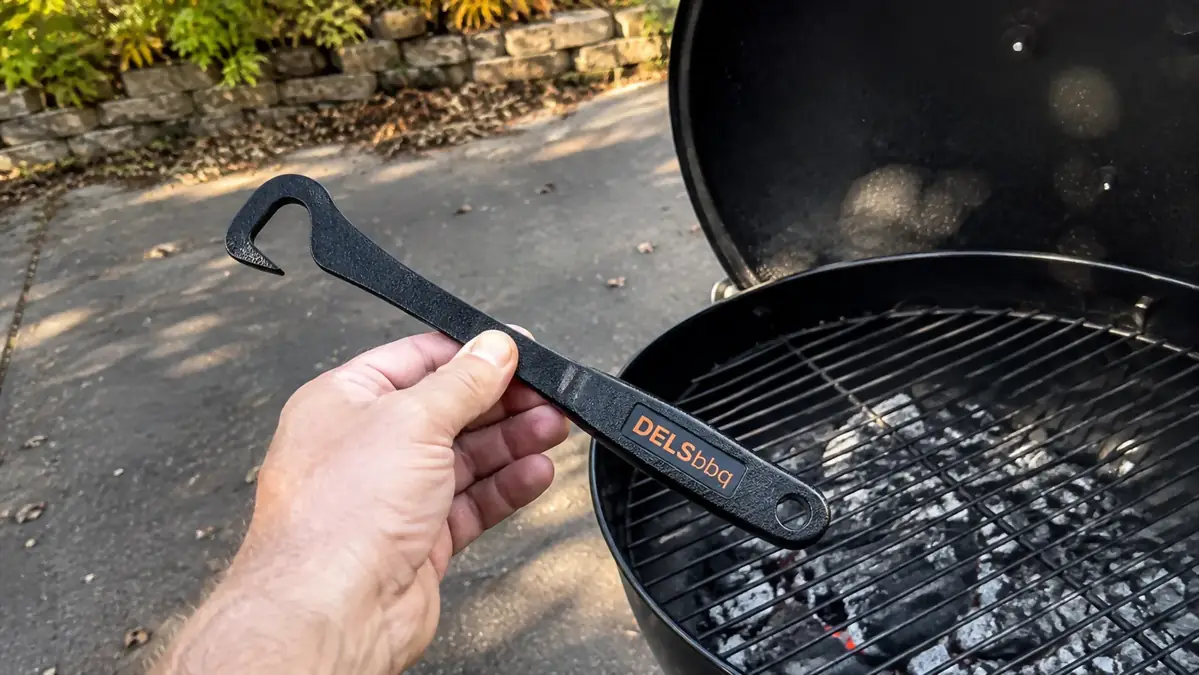
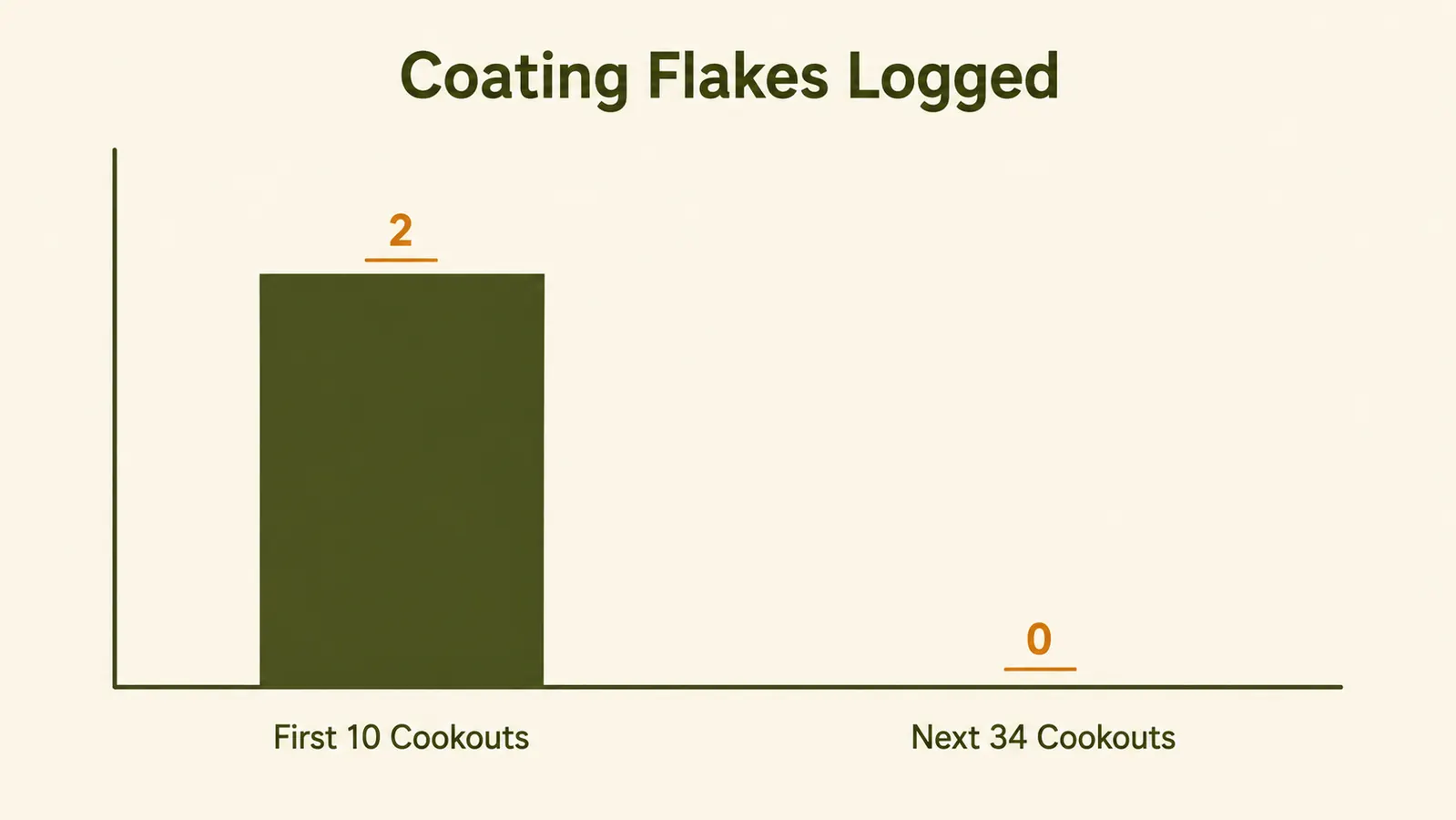
The DELSbbq lifter ships with a factory black coating over the cast iron, and in the first ten cookouts I used it for, small flakes of that coating came loose twice, both times landing on the cooking grate close enough to the food that I had to stop and pick them off before I put anything back on to cook. The first flake came off during a Sunday cook in late April, the second about two weeks later during a weeknight cook when I was in a hurry and leaned the hook against the grate edge harder than I should have.
Here's the part that matters more than the flaking itself: it stopped. Once that first layer of coating wore through to bare seasoned iron near the hook end, I haven't had a single flake in the thirty-four cookouts since. So it's a break-in issue, not an ongoing one, but nobody tells you that going in. If you buy this tool expecting it to be inert cast iron from the first use, you'll be annoyed the first time a black fleck lands near your ribs. Know it's coming, pick it off, and move on.
I'll say this for DELSbbq: the coating issue never affected how the tool gripped or lifted, and it never got worse, only better. Compare that to a cheap stamped-steel lifter I looked at buying instead, which a guy at the hardware store told me flat out chips paint for its whole life because the coating is thinner. This one settles down. It just doesn't settle down on cookout one like the box photos make you assume, and I wish that had been printed somewhere on the packaging instead of me finding out the hard way over two ruined bites of somebody's rib meat.
Where the 'Universal Fit' Isn't as Universal as the Box Claims
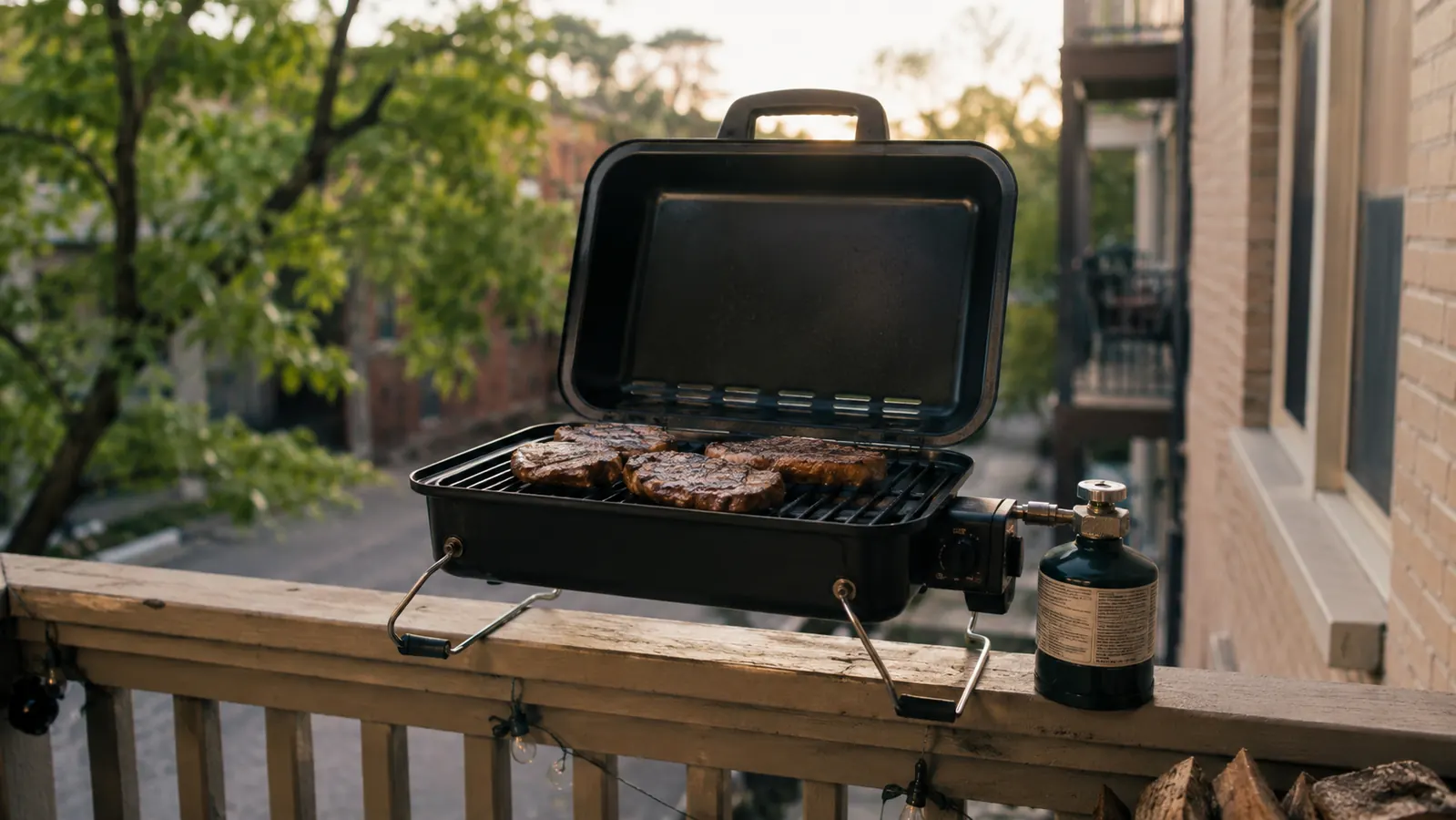
My daughter's boyfriend keeps a small tabletop propane grill on the balcony of his apartment, thin porcelain-coated wire rods instead of the heavier bar-style grate I've got on my kettle. I brought the lifter over for Danielle's birthday cookout, mostly to show it off, and when I hooked it under one of those thin rods to demonstrate, it left a faint scuff where the porcelain coating rubbed. Not a gouge, not bare metal showing through, just a light mark you'd only notice if you were looking for it. Still, that's not nothing on a grate that's supposed to stay non-stick.
On my own kettle and on the pellet rig on the back patio, the fit is exactly as advertised, catches clean every time on the round bar edges those grates use. But the season-long review I wrote didn't mention testing it on anything but heavier-gauge grates, because that's mostly what I own. If your setup runs thin porcelain-coated wire rods instead of solid bars, either skip this tool or go slow and let the hook settle in rather than yanking it under the rod the way I did that day.
How the Grip Holds Up When Your Hands Are Wet or Greasy
This is the complaint I almost forgot to write down, because it only showed up twice in forty-four cookouts, but both times it startled me enough that it earned its own column on the notepad. The handle is bare cast iron with no rubber or textured grip added anywhere along its length. Most of the time that's not an issue, my hands are dry when I'm feeding a fire. But during a rainy Saturday cook in May, and again during a fish fry in July where my hands were greasy from breading catfish, the handle slid a half inch in my grip right as I was setting a loaded grate back down.
Neither slip turned into a dropped grate, but both times my heart rate jumped, and I found myself gripping tighter than I needed to for the rest of the cook just to be safe. A cheap strip of grip tape wrapped around the last few inches of handle would solve this completely, and I've thought more than once about adding my own. As it ships from DELSbbq, though, plan on drying your hands before you reach for it if the weather or the meal has them wet.
The Weight Cuts Both Ways
Cast iron is heavy, and that weight is exactly why the tool feels so steady when you're lifting a full grate with a rack of ribs still on it. But nobody mentions the other side of that coin. On a Wednesday evening cook a few weeks back, tired after a long day, I fumbled the handle setting the grate back down and the lifter itself slipped off the side table and landed an inch from my sandaled foot. Sandals, grilling, and cast iron tools do not belong in the same sentence, and that one's on me, but the tool's weight is exactly why it would have hurt if it had connected.
It's also just tiring to hold at an angle for longer than a few seconds. If you're the kind of cook who likes to prop a grate up and poke around under it while holding the lifter one-handed, your forearm will let you know about it after thirty seconds or so. It's built to hook, lift, and set down quickly, not to be a prop stand. Use it for what it's for and the weight is an asset. Ask it to do something else and it gets old fast, especially if the wet-grip issue and the extra weight show up on the same cook, which happened to me exactly once during that May rain.
What Forty-Four Cookouts Taught Me About the Value
Renata was skeptical when I brought this thing home, mostly because our kitchen drawer already has three sets of tongs, two spatulas that do the same job, and a grill brush I'm pretty sure has never actually been used. Her point was fair: how many single-purpose tools does one grill really need? I didn't have a good answer for her until I added up what I used to go through instead. A ruined dish towel every couple months, singed more than once trying to move a hot grate with it. A pair of grill gloves that got a hole burned clean through the thumb inside a season. Neither of those cost much on their own, but they added up, and neither one actually solved the problem, they just slowed the burn down a little.
What I'd tell Dale, and what I'll tell you, is that the DELSbbq lifter isn't a miracle tool and it's got real flaws. But measured against what it replaced, a towel that eventually failed and gloves that eventually wore through, it's already paid for itself several times over in avoided burns and avoided ruined linens. Check what it costs right now before you decide, but don't expect a flawless nine-dollar tool. Expect a genuinely useful one with a break-in period, a couple of fit limits, and a grip that wants dry hands. For the other jobs it quietly picks up around the grill, this list of everyday uses covers a few I didn't expect either.
What I Liked
- Sturdy cast iron build that hasn't cracked or loosened after forty-four cookouts
- Coating settles down after the first ten uses and stops flaking entirely
- Catches clean on bar-style kettle and pellet grates without fishing for the angle
- Keeps your hand well clear of the heat once you learn to hook and lift in one motion
- Cheaper over a season than replacing burned towels and gloves
Where It Falls Short
- Coating flakes near your food a couple of times before it wears in
- Can leave a light scuff mark on thin porcelain-coated wire rod grates
- Bare handle gets slippery if your hands are wet or greasy
- Heavy enough to hurt if you drop it on a bare foot
- Tiring to hold at an angle for anything longer than a quick lift and set
It's not a flawless tool. It's a genuinely useful one that took ten cookouts to settle in, and I'd still buy it again knowing that going in.
Who This Is For
If you're running a bar-style grate on a kettle or a pellet rig, cooking for a crowd on weekends, and you're tired of ruining towels or burning through grill gloves trying to move a hot grate, this tool solves that specific problem well once you get past the first few uses. It's built for exactly the setup I run, and if yours matches, the fit issue I hit at my daughter's boyfriend's apartment won't apply to you at all.
Who Should Skip It
If your grill uses thin porcelain-coated wire rods, like a lot of small tabletop propane units do, think twice or at least go slow with the hook the first few times. If your hands tend to be wet or greasy mid-cook, like mine were during that catfish fry, plan on drying off first or expect an occasional slip. And if a nine-dollar tool with a short break-in period on the coating is going to bother you more than it saves you, you're better off sticking with whatever you're using now. This isn't a tool for people who need everything to be perfect out of the box.
Now you know the flaws. Here's what it still gets right.
Two coating flakes in the first ten cookouts, one scuffed porcelain rod, and thirty-four cookouts of nothing but clean lifts since. See what it costs right now and decide for yourself.
Amazon Check Today's Price on Amazon →