
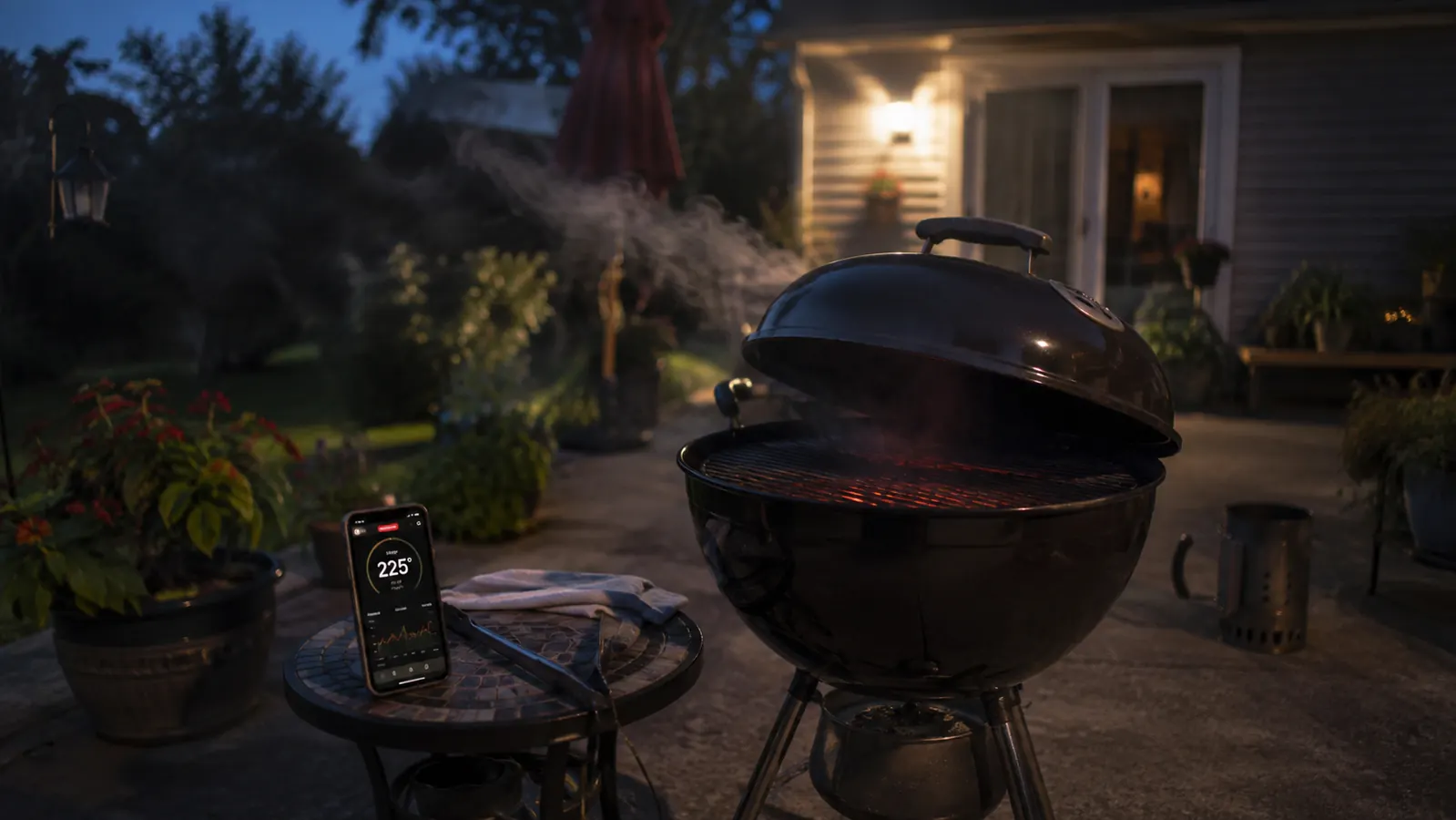
I've stood outside at two in the morning in my sock feet, flashlight clamped in my teeth, cracking the bottom vent a hair on my 22-inch kettle because the dome thermometer had crept up to 260 degrees while I dozed off for forty minutes. That's the honest starting point for this comparison. For years I ran every overnight smoke the only way I knew how: check the temp, nudge a vent, go back to bed, wake up in an hour and do it again. Then I put an Inkbird Wi-Fi fan controller on the kettle for a full season of brisket, pork shoulder, and one very stubborn rack of spare ribs, and I've got real numbers now on which approach actually holds a steady temperature overnight.
Short answer: if you're smoking overnight and you want to actually sleep, the Inkbird controller wins, and it isn't close. If you're cooking during the day, standing near the smoker anyway, and you don't want another gadget with an app and a power cord running across the patio, adjusting the vents by hand still gets the job done and costs you nothing but attention. Neither approach is wrong. They're built for different kinds of cooks, and after a full season I still reach for both depending on what's going in the smoker and what time I'm actually planning to eat.
I should say up front that I didn't buy the Inkbird because vent adjusting had ever ruined a cook outright. It hadn't. I've been smoking on that kettle for close to eight years and I know how to read it. What wore me down was the schedule. A 14-hour brisket cook means waking up four or five times through the night no matter how good you are at it, and after a stretch of weekends doing that for church potlucks and Danielle's friends, I wanted to know if a machine could actually do it better than I could half asleep.
| Inkbird Fan Controller | Adjusting Vents by Hand | |
|---|---|---|
| Cost to get set up | Requires buying the controller and running a power cord to the smoker | Nothing to buy, uses the vents already built into the smoker |
| Overnight temperature swing | Held within about 5 degrees of my 225 target for 9 hours straight | Swung about 20 degrees between checks on a windy night |
| Sleep interruptions on a 12-hour cook | Zero, the phone alarm only fires if something's actually wrong | 3 to 4 alarm-clock checks through the night |
| What can go wrong mid-cook | Fan motor, wiring, or the Wi-Fi connection can all fail | Nothing electronic to fail, worst case is a sticky damper |
| Response to a sudden temperature drop | Fan kicks in within seconds of the pit probe dropping | Only as fast as you notice and walk outside |
| Skill you build over time | The controller does the thinking, you learn less about your fire | You learn how your specific smoker actually breathes |
| Best fit for gusty Ozark nights | Fan compensates automatically as wind pulls heat through the vents | Wind changes faster than most people can keep checking |
Where the Inkbird Wins
The Inkbird controller earns its keep on long, unattended cooks, and that's really the whole pitch behind it. I ran a 14-pound brisket through an overnight smoke back in March, started the fire at 9pm, and the pit probe never drifted more than 5 degrees off my 225 target the entire night. The fan kicks on for a few seconds, backs off, kicks on again, all handled by an algorithm that's frankly better at small corrections than I am at 3am with my eyes half shut. I slept from 11pm straight through to 6am, which hadn't happened on a brisket cook since Owen was still living at home and I could bribe him to take the midnight shift.
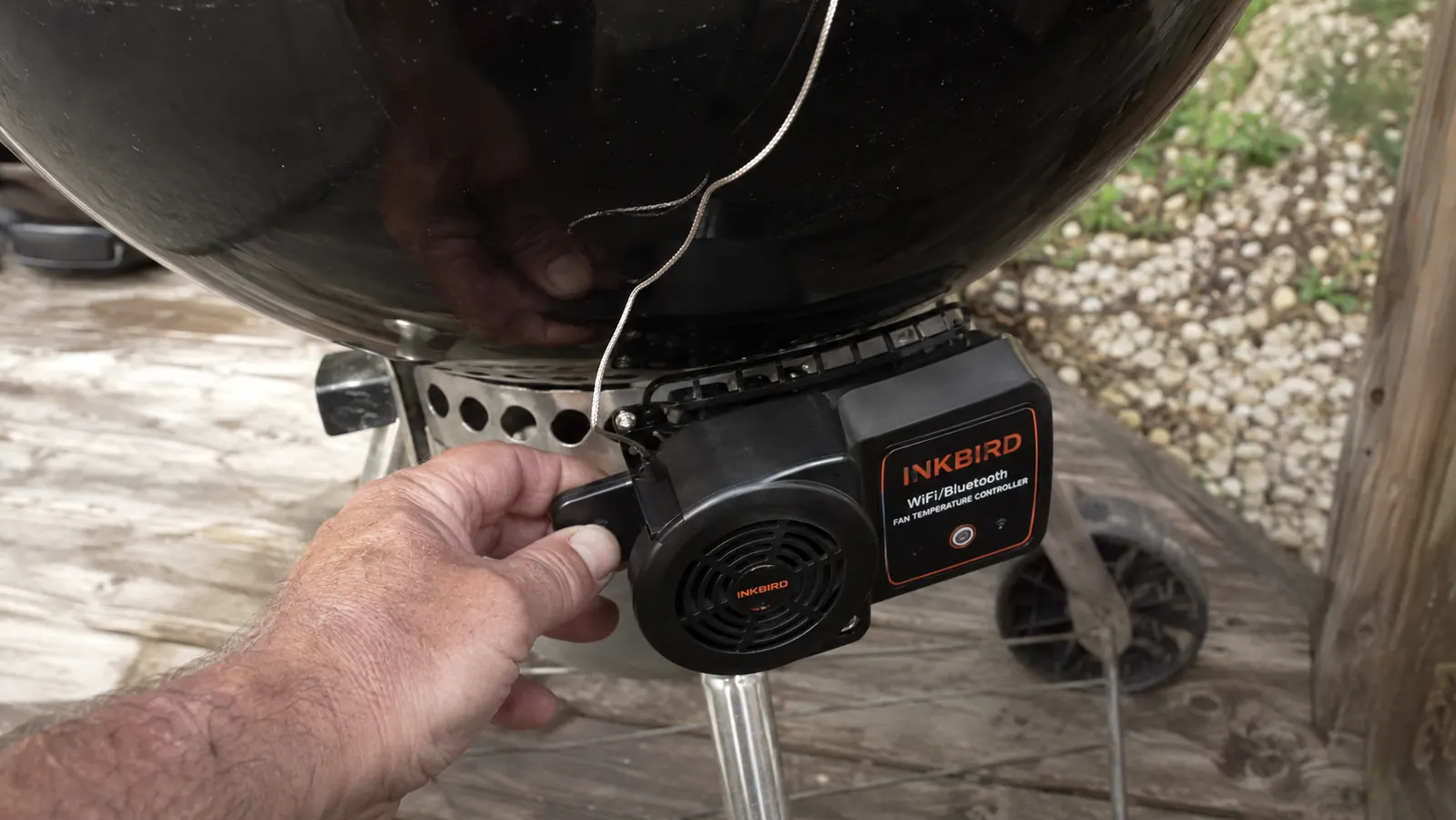
The other place the Inkbird pulls ahead is wind. My back patio sits open to whatever comes across the field behind the house, and a gusty night used to mean I was up every 45 minutes instead of every 90. Read the full Inkbird temperature controller review for the season-long breakdown, but the short version is the fan compensates for wind pulling heat through the vents faster than I can react to it, because it's reading the actual pit probe instead of the dome thermometer, which lags behind by several minutes on my kettle.
There's also the alarm, which I didn't expect to matter as much as it does. I set a high and low range on the app before I go to bed, and if the temperature actually leaves that window, my phone buzzes. Everything else, the controller just handles quietly in the background. That peace of mind is worth more to me than the steadiness itself most nights, because it means I don't wake up out of pure habit and check a phone that has nothing to tell me. I ran six overnight cooks total this season with the controller, and the alarm only fired twice, both times because I'd loaded the hopper light and the fire needed more fuel, not because the controller itself had a problem.
Where Adjusting Vents by Hand Wins
Hand-adjusting the vents wins on cost, and it isn't close. There's nothing to buy, nothing to charge, and no cord to run across the patio where Renata will trip on it carrying out the coleslaw. Every kettle and most offset smokers already come with the dampers you need built right in. You're not out a dime, and you're not waiting on a replacement part to ship if something breaks the week before a big cook.
It also wins on simplicity and on what can actually fail. A fan controller has a motor, a power supply, a Wi-Fi chip, and a probe wire, and any one of those can quit on you mid-cook. I've had the app lose its connection to the controller twice this season, both times during a thunderstorm that knocked the router offline for a few minutes. Vents can't lose Wi-Fi. Worst case with a manual setup is a damper that's rusted stuck, and you can usually work that loose with a gloved hand and a little patience, no troubleshooting required.
There's a cold-weather angle too that I didn't think about until December. I ran a pork shoulder in freezing temperatures and the fan motor ran almost constantly trying to keep up with how fast the kettle was losing heat, which made me nervous about how hard I was working that little motor. Vents don't care what the weather's doing. You crack them a bit further on a cold night and that's the whole adjustment, no motor cycling, no battery to worry about, no app losing its patience with the cold same as I do.
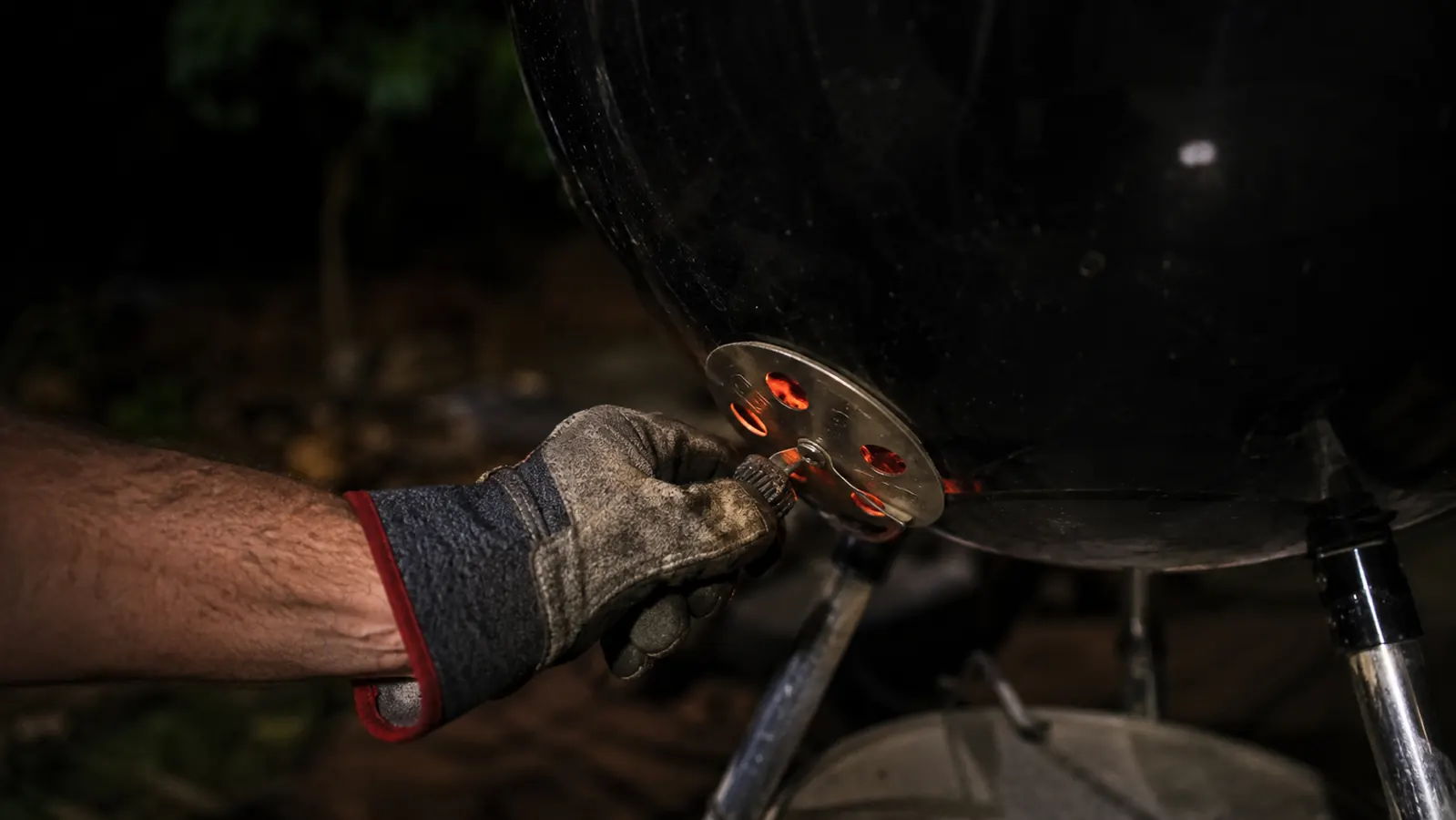
And there's something to be said for what you actually learn doing it the old way. Adjusting vents by hand forces you to pay attention to smoke color, to how the coals are burning down, to how your particular smoker behaves when the wind shifts or the outside temperature drops ten degrees after midnight. My neighbor Gil still runs his offset entirely by feel and honestly reads a fire better than I do, because he's never had a machine do that thinking for him. If you're new to smoking and want to actually understand your equipment before you automate any part of it, doing it by hand for a season or two isn't wasted time, it's the education that makes the Inkbird make sense later.
The Inkbird will hold your temperature steadier than you ever will at three in the morning. It won't teach you a single thing about your fire.
Tired of losing sleep over a smoker that won't hold steady?
See today's price on the Inkbird Wi-Fi fan controller and find out if it fits your setup.
Amazon Check Today's Price on Amazon →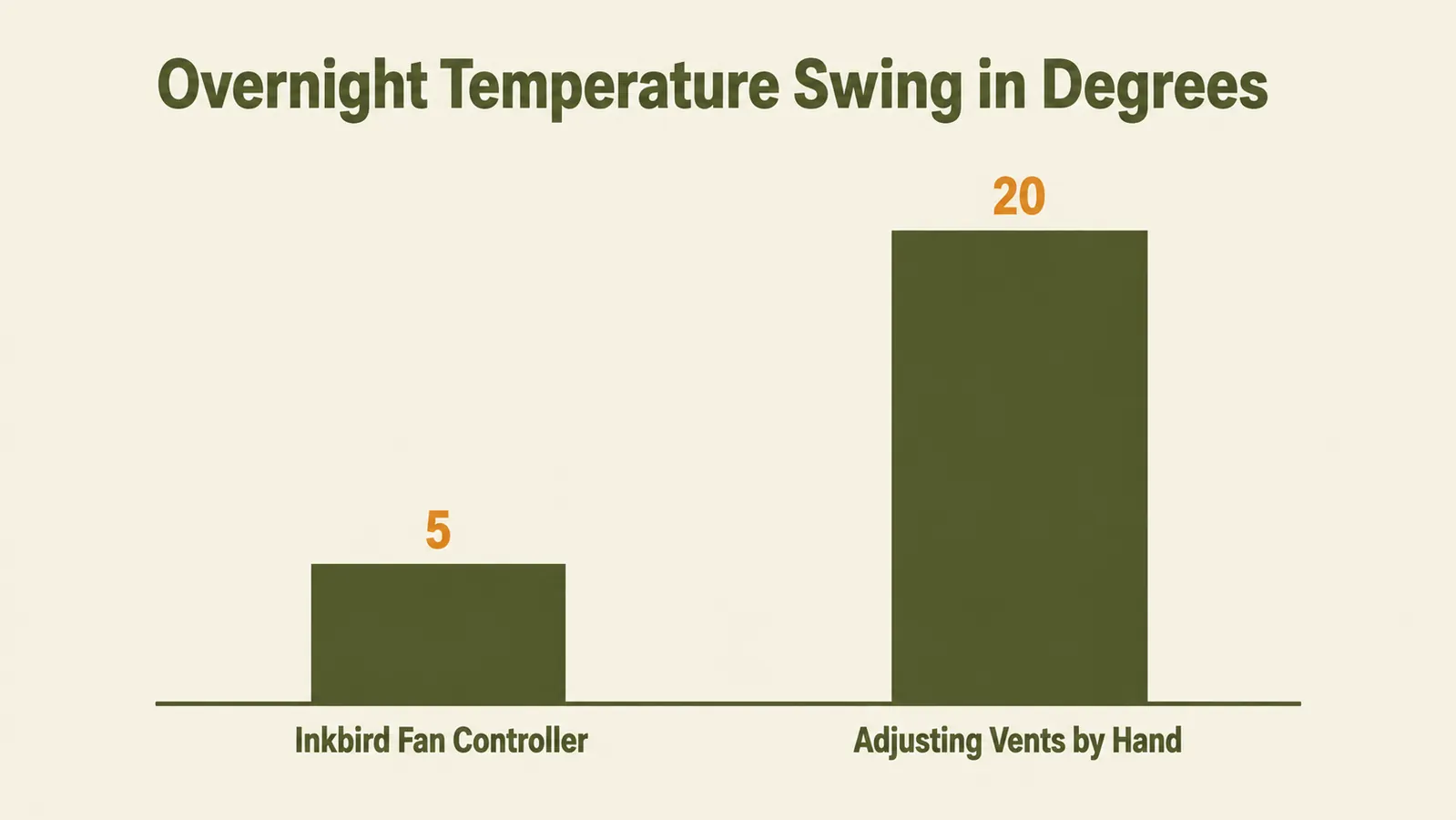
What Changed on My Overnight Cooks
Before the Inkbird, I planned every overnight brisket around when I'd have to get up, not around when I actually wanted to eat. I'd start a cook at midnight instead of 9pm just to shrink the number of times I had to check it before sunrise, which meant dinner kept sliding later and later into the afternoon. Renata stopped planning family time around my smoke schedule entirely for a while there, which tells you something about how much that old routine was costing us.
With the controller running, I can start whenever the cook actually needs to start and trust the temperature will still be close to where I left it eight or nine hours later. That one change is worth more to the way we actually eat as a family than the 5-degree swing number suggests on paper. If you want the exact setup, including where I put the pit probe and how I mounted the fan bracket on the kettle, I wrote up every step in how to hold a steady smoker temperature overnight. It took me two cooks to get the probe placement right, and I'll save you that trial and error.
I'll also say the Inkbird hasn't replaced hand-adjusting vents entirely on my patio, it's just replaced it for the cooks where sleep matters. On a Saturday afternoon rack of ribs that only runs three hours, I'm standing right there anyway, so I still crack the vents by hand and skip pairing the app at all. The controller comes out for the cooks that cross midnight, and honestly that split has worked out better than picking one method and sticking with it out of stubbornness.
Who Should Buy Which
If you cook overnight more than a couple times a month, or you've got a job that has you up early regardless of how the smoker did, buy the Inkbird. The steadiness and the sleep are worth it, and you'll make the investment back in fewer ruined cooks and fewer dry brisket flats from a fire that crept too hot while you were out cold. If you mostly grill during the day, cook things that finish in under three or four hours, or you genuinely enjoy the process of tending a fire by hand, save your money and stick with the vents you've already got. There's also a middle case worth naming: if you're still building your fire sense as a newer cook, I'd actually recommend a season of hand-adjusting first before you automate anything. Read the reasons a fan controller fixes temperature swings once you've felt that 2am vent-check problem firsthand yourself, it'll mean a lot more than it would right now.
Ready to stop losing sleep over vent checks?
The Inkbird controller is what finally let me sleep through a full brisket cook without setting an alarm. See today's price and specs on Amazon before your next overnight smoke.
Amazon Check Today's Price on Amazon →